This blog is going into hibernation until further notice. I had hoped to make a post on this blog at least once a month, but various circumstances have intervened.
I have been rejected for treatment by the district health board for my rare dental condition, on the grounds that I'm not sick enough, and as a result I have sought treatment for depression and PTSD resulting from the prospect of becoming an American-style medical debt statistic. Despite the best efforts of my usual dental professionals and my local MP, the health board has so far refused to budge. From the Health Minister's response, he seemed to recommend an instalment plan, which would only paper over the cracks - I'd still be out of pocket for the same amount regardless of whether I pay up front or over time. I could get subsidised dental surgery if I had a Community Services Card, but to qualify for one I'll have to take a pay cut, although in fairness I'd probably get a shorter working week in return. Besides, I'm already working 6 days a week and my work-life balance needs fixing.
You know a nation's priorities are screwed up when it supposedly can't afford medical treatment for its citizens, but it can somehow afford to dole out pork barrels to industries with all the right political connections, especially sunset industries like the Tiwai Point smelter.
I went to the Armageddon Expo over Queens Birthday weekend, and that still didn't cheer me up much. Most of my friends decided not to attend this year's event, and many of the more novel attractions have been cancelled or have otherwise faded into oblivion. A case in point was the anime music video contest, largely due to rule changes that effectively strangled the creativity of its entrants. In fairness, anime itself also seems to have reached a saturation point.
On top of all that, my current job is facing obsolescence due to changing trends in technology. My skills are effectively out of date, and upskilling doesn't come easy or cheap these days. My future career hopes now hinge on a mentorship with the local branch of an ICT industry organisation.
I've also been finding that much of what I'm currently writing about is already being covered by others, so I am feeling a lesser need to reinvent the wheel. I'll still be active in the Twitterverse and various specialist Web forums, since micro-blogging seems the best alternative for me to long-form blogging, and you'll see my Twitter feed on the sidebar.
Now hibernating...

"I regret to say that we of the FBI are powerless to act in cases of oral-genital intimacy, unless it has in some way obstructed interstate commerce." — J. Edgar Hoover
Wednesday 4 June 2014

Monday 27 January 2014
Just when I thought I'd broken the habit
If you're wondering why this blog has been a bit quiet lately, I regret to inform that just when I thought I had broken the habit... I've started playing World of Warcraft again.
This time round, I've been power-levelling a new warlock toon who has reached level 66 as of writing. And as you can see, she's a bit on the shameless side. Some people still take the issue of female armour a tad too seriously though.

With yet another expansion announced, there's still more to come. It's nothing short of remarkable that a game originally released 10 years earlier - albeit with mid-life upgrades - is still dominating its market segment, despite sagging subscription numbers and challenges from various competitors. Star Wars: The Old Republic & Twin Galaxies, City of Heroes, DC Universe, All Points Bulletin - all have attempted to make a dent in WoW's grip on the MMORPG sector, but have either shut down or gone free-to-play. EverQuest, EVE Online and Ultima Online still have a small but loyal following, but aren't about to knock WoW off its throne anytime soon.
At this stage, there seems to be only one thing that will kill Warcraft, and that's Warcraft itself. Pathfinder Online, which has successfully crowd-funded its way into progress, remains the only potential contender that could take on the Warcraft franchise at its own game.
In the meantime, there'll be new lands to explore, and more demons, ghouls, beasts, elementals and bandits to hack into little pieces. Or in the case of my warlock, burn to a crisp with the utmost glee.
This time round, I've been power-levelling a new warlock toon who has reached level 66 as of writing. And as you can see, she's a bit on the shameless side. Some people still take the issue of female armour a tad too seriously though.
With yet another expansion announced, there's still more to come. It's nothing short of remarkable that a game originally released 10 years earlier - albeit with mid-life upgrades - is still dominating its market segment, despite sagging subscription numbers and challenges from various competitors. Star Wars: The Old Republic & Twin Galaxies, City of Heroes, DC Universe, All Points Bulletin - all have attempted to make a dent in WoW's grip on the MMORPG sector, but have either shut down or gone free-to-play. EverQuest, EVE Online and Ultima Online still have a small but loyal following, but aren't about to knock WoW off its throne anytime soon.
At this stage, there seems to be only one thing that will kill Warcraft, and that's Warcraft itself. Pathfinder Online, which has successfully crowd-funded its way into progress, remains the only potential contender that could take on the Warcraft franchise at its own game.
In the meantime, there'll be new lands to explore, and more demons, ghouls, beasts, elementals and bandits to hack into little pieces. Or in the case of my warlock, burn to a crisp with the utmost glee.
Wednesday 20 November 2013
Roast Busted
The infamous Roast Busters rape cult group has brought out the best and worst in New Zealanders.
After RadioLive talkback hosts Willie Jackson and John Tamihere belittled a caller "Amy" who was targeted by the Roast Busters, Wellington-based blogger Giovanni Tiso immediately contacted RadioLive advertisers to express his concerns. The results were remarkably effective: the advertisers pulled their sponsorship of Willie & JT's segment, the two talkback hosts were put on gardening leave, and debates on rape culture and freedom of speech were sparked. Night-time RadioLive hosts Andrew Fagan and Karyn Hay argued over it so much that Fagan was made to walk all the way to the studio and eat humble pie.
This isn't the first time advertisers have pulled out in response to live broadcast controversies in NZ. Paul Holmes' 'cheeky darkie' remarks prompted Mistubishi to pull its sponsorship - even without encouragement from citizens.
Rape culture is nothing new, but the advent of social media - particularly with the gloating of the Roast Busters about their acts on Facebook - has thrown it straight in our faces. To throw petrol on the fire, the Roast Busters were found to be well-connected, with one of them being the son of a well-known actor, and another happening to be the son of a police officer. The initial reluctance of the police to investigate only fuelled further suspicions, in wake of the Maryville and Steubenville rape trials which have been dogged by corruption, nepotism, and victim blaming. The police claimed the girls involved didn't come forward, when actually they did, or if they didn't, then they were too intimidated to come forward. Contrasts have drawn with the rapid zeal displayed by the police with the raids on Kim Dotcom and the Urewera 16.
Victim blaming in particular has popped up with the Roast Busters controversy. Not long after the 2000 Sydney gang rapes, the then Grand Mufti of Australia, Sheik al-Hilaly, controversially remarked:
Some have seen fit to similarly play the uncovered meat card with the Roast Busters. CK Stead garnered criticism from Booker Prize winner Eleanor Catton when he complained about "collective hysteria" over the Roast Busters. On RadioNZ's The Panel, Don Donovan rubbed it in by blaming scanty dress sense for rape culture. Retired NZ Herald columnist and professional curmudgeon Garth George basically blamed the over-sexualisation of society. Still others think the Roast Busters are just boys being boys - or, more accurately, "young, dumb and full of cum" - and that it's all just a normal rite of passage. Memo to the victim-blamers: clothes or pornography don't cause rape. Rapists cause rape. If skimpy clothes caused rape, then burqa-clad women in the Middle East and habit-clad nuns in papal societies would be free from violence and sexual assault. Which is far from the case.

Meanwhile, the normally vocal Sensible Sentencing Trust was surprisingly not very vocal about the controversy, despite overwhelming disapproval of the Roast Busters on its Facebook page - maybe no one's been sentenced yet? Maybe the Roast Busters don't fit the SST's favoured stereotype of a crim?
Professional curmudgeon Karl du Fresne wisely avoided victim blaming, but still resorted to the hoary old lynch mob card, believing that Tiso's success in convincing advertisers to boycott Willie & JT was a chilling effect on free speech.
In particular with regards to du Fresne, what Tiso did was hardly censorship, just good old civil disobedience. It's not like Willie & JT are being shipped off to Guantanamo Bay, or the RadioLive studios being stormed by gun-toting Ministry of Truth goons. That Tiso managed to convince advertisers to exercise a legit business decision that the Shock Doctrine Set have a problem with, is all the more amusing. It seems the real reason why the Shock Doctrinists lump acts of civil disobedience like Tiso's in with censorship, is because they know it gets results. Just not the results they like.
After RadioLive talkback hosts Willie Jackson and John Tamihere belittled a caller "Amy" who was targeted by the Roast Busters, Wellington-based blogger Giovanni Tiso immediately contacted RadioLive advertisers to express his concerns. The results were remarkably effective: the advertisers pulled their sponsorship of Willie & JT's segment, the two talkback hosts were put on gardening leave, and debates on rape culture and freedom of speech were sparked. Night-time RadioLive hosts Andrew Fagan and Karyn Hay argued over it so much that Fagan was made to walk all the way to the studio and eat humble pie.
This isn't the first time advertisers have pulled out in response to live broadcast controversies in NZ. Paul Holmes' 'cheeky darkie' remarks prompted Mistubishi to pull its sponsorship - even without encouragement from citizens.
Rape culture is nothing new, but the advent of social media - particularly with the gloating of the Roast Busters about their acts on Facebook - has thrown it straight in our faces. To throw petrol on the fire, the Roast Busters were found to be well-connected, with one of them being the son of a well-known actor, and another happening to be the son of a police officer. The initial reluctance of the police to investigate only fuelled further suspicions, in wake of the Maryville and Steubenville rape trials which have been dogged by corruption, nepotism, and victim blaming. The police claimed the girls involved didn't come forward, when actually they did, or if they didn't, then they were too intimidated to come forward. Contrasts have drawn with the rapid zeal displayed by the police with the raids on Kim Dotcom and the Urewera 16.
Victim blaming in particular has popped up with the Roast Busters controversy. Not long after the 2000 Sydney gang rapes, the then Grand Mufti of Australia, Sheik al-Hilaly, controversially remarked:
"If you take out uncovered meat and place it outside on the street, or in the garden or in the park, or in the backyard without a cover, and the cats come and eat it ... whose fault is it, the cats' or the uncovered meat? The uncovered meat is the problem. If she was in her room, in her home, in her hijab, no problem would have occurred."
Some have seen fit to similarly play the uncovered meat card with the Roast Busters. CK Stead garnered criticism from Booker Prize winner Eleanor Catton when he complained about "collective hysteria" over the Roast Busters. On RadioNZ's The Panel, Don Donovan rubbed it in by blaming scanty dress sense for rape culture. Retired NZ Herald columnist and professional curmudgeon Garth George basically blamed the over-sexualisation of society. Still others think the Roast Busters are just boys being boys - or, more accurately, "young, dumb and full of cum" - and that it's all just a normal rite of passage. Memo to the victim-blamers: clothes or pornography don't cause rape. Rapists cause rape. If skimpy clothes caused rape, then burqa-clad women in the Middle East and habit-clad nuns in papal societies would be free from violence and sexual assault. Which is far from the case.
Meanwhile, the normally vocal Sensible Sentencing Trust was surprisingly not very vocal about the controversy, despite overwhelming disapproval of the Roast Busters on its Facebook page - maybe no one's been sentenced yet? Maybe the Roast Busters don't fit the SST's favoured stereotype of a crim?
Professional curmudgeon Karl du Fresne wisely avoided victim blaming, but still resorted to the hoary old lynch mob card, believing that Tiso's success in convincing advertisers to boycott Willie & JT was a chilling effect on free speech.
In particular with regards to du Fresne, what Tiso did was hardly censorship, just good old civil disobedience. It's not like Willie & JT are being shipped off to Guantanamo Bay, or the RadioLive studios being stormed by gun-toting Ministry of Truth goons. That Tiso managed to convince advertisers to exercise a legit business decision that the Shock Doctrine Set have a problem with, is all the more amusing. It seems the real reason why the Shock Doctrinists lump acts of civil disobedience like Tiso's in with censorship, is because they know it gets results. Just not the results they like.
Thursday 24 October 2013
Anti-PC gone mad #4: Auckland and London
Len Brown pants down, John Palino don't know
Much has already been written on Auckland Mayor Len Brown's extra-marital affairs - maybe a bit too much. He's exercised a rather silly lapse of judgement - especially when it involves an employee close to the city council - and he's reached that age where he probably needs to buy himself a very fast car to channel his 'energies'.

At the same time, it seems those who have lobbed political grenades at Mayor Brown have found the hard way that grenades can bounce back in the faces of the lobbers. Whaleoil, the blogger who published the scandal, denies that the purpose of it was to destroy Brown's mayoral career. Brown's arch-rival John Palino admits to have met Brown's mistress, Bevan Chuang, but also denies his own involvement in the scandal.

To make things more interesting, one of Palino's more 'enthusiastic' campaign managers, Luigi Wewege, has been found out to be a Walter Mitty/John Davy type who was warned about by National Party sources as 'toxic'. One of these sources has gone in to bat for Chuang, who it emerges was cajoled into revealing the affair by Team Palino, and has strongly criticised Whaleoil for his dirty tricks tactics.
Meanwhile, in Britain...
From the New Statesman:
A response from Peter Kennard and Cat Phillips: Censorship is flourishing in our "public spaces"
Their Tony Blair "selfie" was recently banned from public display after advertisers refused to display the image. Here Peter Kennard and Cat Phillips speak out about the censorship of their work.

Saturday 31 August 2013
Rainbow's End with Roving Spheres
With the passage of the GCSB Amendment bill by just a couple of votes, such a move towards mass surveillance has polarised New Zealanders. Those in favour of this creeping illiberality typically invoke the hoary old "if you have nothing to hide, you have nothing to fear" argument, which has been popularly attributed to a number of repressive dictators in history. It's been mentioned as early as the late 19th century:
"If these people had done bad things they ought to be ashamed of themselves and he couldn't pity them, and if they hadn't done them there was no need of making such a rumpus about other people knowing."Just to rub it in, the NZ Police have declined to press charges involving the GCSB wilfully straying outside of its lawful jurisdiction, claiming there was no evidence of 'criminal intent'. To privacy advocates, it gives the impression of a Government agency given carte blanche to be a law unto itself.
Not surprisingly, hacker collective Anonymous has announced it's expanding its operations in NZ. Already they've defaced the web sites of the GCSB and various Government ministers who voted for the law changes, and have promised more. Kim Dotcom, a cause celebré of the Internet privacy movement, has come out against such defacement, saying it only gives supporters of cyber-snooping more ammunition.
On the other hand, with the Key Government seemingly unstoppable and a political Opposition still to get its act together, JFK's wisdom comes to mind: "Those who make peaceful revolution impossible, will make violent revolution inevitable." Only this time, there are no guns or bombs, only laptops and the Internet.
Already, those who increasingly speak out against the Government - Natasha Fuller, Mike Joy, Jon Stephenson - are come down upon with the full force of its propaganda machine. Recent proposals to ban protests against offshore oil drilling only consolidate such intolerance of dissent. If Singapore is "Disneyland with the Death Penalty" according to William Gibson, then NZ is increasingly becoming Rainbow's End with Roving Spheres.
And then there were three...
It was only a matter of time before the Leader of the Opposition, David Shearer, would throw in the towel. From Day 1, he gave the impression of being parachuted into the role, and struggled to come across as coherent. And the timing of his resignation was a bit off. Yet if he makes it to Cabinet, he'd probably be effective in the Foreign Affairs portfolio, his old stomping ground.
Jostling for the newly vacated seat are David Cunliffe, Grant Robertson, and Shane Jones, who each represent different segments of the public voter base.
David Cunliffe

Cunliffe comes across as the "broad church" candidate who happens to be very focused about his policy platform, with a Fulbright scholarship and Harvard MPA (not MBA) to boot. He manned up and unbundled Telecom's local loop in 2006 in the face of resistance from the finance sector, which had profited handsomely from a cartellised telco market. To his detractors, he comes across as an aloof prima donna, and seems to be far more popular with the party rank-and-file and public than within his own caucus. Still, much of the NZ Labour caucus is weighed down with dead wood, and he probably has the best chance of taking on John Key at his own game.
Grant Robertson

Robertson is seen as the "beltway insider". I'm not a big fan of the term "beltway" in a NZ context, because it's been invoked to dismiss burning issues like the GCSB as not being on the public radar. He has a good grip on how the machinery of Government works, and holds his own in the Parliamentary debating chamber. Supposedly counting against him is his open homosexuality, following the controversy over the legalisation of same-sex marriage. Such arguments are playing the man instead of the ball (and Robertson is a keen follower of the rugby scene), though, and I'm firmly of the view that Robertson's sexual orientation is a non-issue. If anything potentially counts against him, it's his Wellington insider status which only those with a fascination for politics are seen to be interested in. He's still a solid candidate who's done the hard yards in his electorate Wellington Central, and would make the perfect deputy leader.
Shane Jones

Jones is the "red-blooded" or "Waitakere Man" candidate who was in the news for the wrong reasons not too long ago, namely for charging porno flicks to the taxpayer. He has swing voter appeal, where modern elections are supposedly won and lost, and like Cunliffe went to Harvard and has a grounding in business. However, his red-bloodedness has gotten him offside with environmentalists and women, and his relations with the Green Party will prove rather interesting if he becomes a Cabinet minister.
While Jones is an outside chance for the leadership, he'll still be effective on the front bench despite his personal flaws.
More pork
As there's no guarantee the smelter will remain open after 2017, the subsidy isn't about smelter jobs and the Southland economy. It's really about fattening up Meridian Energy, the provider of electricity to the smelter, for floating on the sharemarket. While public services like the Department of Conservation are laying off staff and we're lectured about the cupboard being bare, the Government of the day somehow manages to find large sums of money to subsidise highly profitable multi-nationals. Bill English, from an old-school Treasury background, is telling us to do as he says, not as he does. If it isn't socialism for the rich and austerity for the rest of us, I don't know what is.
If a Labour-led Government was in the same position, it might have screwed down Meridian Energy or put in a jobs readjustment plan for a post-smelter future, both of which would be anathema to the increasingly discredited and hypocritical Wall Street orthodoxy that those currently in power cling to at all costs.
Wednesday 31 July 2013
The GCSB: Big Bro Is Watching You
In a direct follow-up to my previous post, my latest print design is out now on CafePress:

And what better way to kill two birds with one stone? Both the reality TV series The GC, and the Government Communications Security Bureau (GCSB) are right now prime objects of scorn. The former, because it's a Jersey Shore rip-off at heart. And the latter, because the New Zealand Government is extending the powers of the cyber-snooping agency onto its own citizens.
The revelation that investigative journos have been placed on a Defence Force list of subversives can only pour petrol on an already burning issue - the issue of mass surveillance, which seems to be getting to the point where it's breaking out of the beltway and into the public consciousness. With enough momentum, it could even become the No Nukes of the Smartphone Age.
There are genuine terrorist threats to chase after - but the beefing up of the GCSB's powers is less about countering terrorism, and more about senior political figures trying to save both their arses and their faces at once. The sinking of the Rainbow Warrior by French secret agents - the first and only international terrorist attack in NZ - was quickly solved with good old-fashioned police detective work. Some degree of beefed-up security agencies was a given in the wake of 9/11, but there comes a turning point where temporary states of emergency become permanent ones, and that's where the misuse and abuse starts.
And what better way to kill two birds with one stone? Both the reality TV series The GC, and the Government Communications Security Bureau (GCSB) are right now prime objects of scorn. The former, because it's a Jersey Shore rip-off at heart. And the latter, because the New Zealand Government is extending the powers of the cyber-snooping agency onto its own citizens.
The revelation that investigative journos have been placed on a Defence Force list of subversives can only pour petrol on an already burning issue - the issue of mass surveillance, which seems to be getting to the point where it's breaking out of the beltway and into the public consciousness. With enough momentum, it could even become the No Nukes of the Smartphone Age.
There are genuine terrorist threats to chase after - but the beefing up of the GCSB's powers is less about countering terrorism, and more about senior political figures trying to save both their arses and their faces at once. The sinking of the Rainbow Warrior by French secret agents - the first and only international terrorist attack in NZ - was quickly solved with good old-fashioned police detective work. Some degree of beefed-up security agencies was a given in the wake of 9/11, but there comes a turning point where temporary states of emergency become permanent ones, and that's where the misuse and abuse starts.
Thursday 27 June 2013
Nothing to hide, nothing to fear. Yeah right.
With the NSA contractor Ed Snowden turning rogue and spilling the beans on the PRISM network he was once party to, things are certainly ramping up in our own backyard as well.
The Government's embarrassment over the Kim Dotcom affair and Operation 8 have led it to change electronic spying law to effectively legitimise illegal actions by intelligence and law enforcement agencies.
And just to rub it in, Silicon Valley's most powerful companies would be forced to open their data to the GCSB under the proposed Telecommunications Interception Capability and Security (TICS) Bill. Prime Minister Key has already played the 'soft on terrorism' card, which doesn't seem to wash with many.
There's a school of thought that there was a full-on dossier on the 9/11 plot before it happened, but that it was not acted on by President Bush Jr despite the necessary intelligence apparatus being in place. And there were claims that Russia did actually have some good old-fashioned intelligence on the Tsarnaev brothers who pulled off the Boston Marathon bombings, but that the FBI, CIA and Homeland Security didn't take them seriously. If true, all this can only stoke suspicions that we're in a perpetual war with Eastasia.
In the words of American founding father Benjamin Franklin, "those who would give up essential liberty to purchase a little temporary safety, deserve neither liberty nor safety."
To finish off, here are some real adverts that go to show that life has imitated art.

Thursday 30 May 2013
Will the last person leaving Wellington please turn out the lights?
Commercial vacancies are at their highest in Wellington since the early 1990s, when the city was still reeling from the fallout of the 1987 sharemarket crash, and since then there's been considerable head office and industrial drift to NZ's largest city, Auckland, where most of the big jumbo jets land.
The public sector purge has had a noticeable divider effect on Wellington, and making matters worse is the jump in insurance premiums following the Christchurch earthquakes, which has hit many inner city residents and businesses in the pocket. The increased focus on Auckland's super-city status and the Christchurch rebuild have also drawn attention away from Wellington. Diversification into the film, arts, technology and finance sectors has picked up some of the slack, but even then, more jobs have still been lost than created.

And despite what the Government would have us believe, the public sector purge has proven to be false economy, and the money supposedly saved has instead been channelled towards a small number of expensive private consultants who are basically paid to say what the Government wants to hear. It goes to show the cuts aren't so much about returning to surplus, but more about blatant anti-intellectualism and Ministry of Truth-iness.
To add insult to injury, our normally optimistic (or should that be Stepfordish) PM John Key remarked that Wellington was a "dying city" and that he "didn't know how to turn it around". While Wellington is undoubtedly fighting an uphill battle, it's hardly dying by any means. Even Auckland's public figures thought the remarks were bollocks. By the sounds of it, he's never been to a properly dying city like Detroit, more of which will be mentioned below.
Working in a bricks-and-mortar based retail and services company right now, I can very much sense the entire sector is under assault on multiple fronts.
Many cities have lived and died on a single dominant industry, and ghost towns near abandoned mines are just one example. Take the case of two major American cities, Seattle and Detroit. Both cities made it big as heavy industry outposts, in aerospace and motor vehicles respectively. Both cities stagnated in the 1970s as the major companies they depended on hit the rocks. U-Haul reported that it ran out of trailers because of the sheer numbers of people moving out of Seattle following the Boeing Bust, and Detroit was reeling from the 1967 riots and the Big Three facing foreign competition and moving more of its operations out of Detroit.
Yet Seattle eventually bounced back, while Detroit remains in the doldrums to this day. It helped that Seattle always had a more diverse economic base than Detroit, and Boeing had a higher proportion of highly educated workers than the Big Three. It also helped that a young man named Bill Gates moved a small company called Microsoft to Seattle's outskirts in 1979, which much of Seattle's know-how would go on to work for. And this know-how in turn fostered the likes of Amazon.com, Valve Software, and Nintendo of America. By contrast, industrial giants like Boeing and the Big Three had very limited spin-off effect.
Closer to home, the late science professor Paul Callaghan had a vision of New Zealand as 'a place where talent wants to live'. Right now, we seem to be a place where talent wants to leave, and where making it big is largely about who you know instead of what you know - the sign of a patronage economy. PolarBearFarm founder Layton Duncan's move to Melbourne is a microcosm of why such talent is leaving. Pegasus Mail creator David Harris - a favourite son of Dunedin - warned 10 years ago that it would happen. Recent deals like that of the Sky City pokies-for-convention-centre deal give the impression that the nation is being run from a golf cart in a North Shore country club, or from the back seat of a Rolls-Royce.
With every man and his dog moving to Auckland for work, the city is experiencing a shortage of housing which the Auckland Mayor Len Brown and Environment Minister Nick Smith are locking horns over - Mayor Brown wants Auckland to build taller, while Minister Smith wants Auckland to build fatter. It's an issue that major cities the world over are grappling with, and in NZ it has the added layer of political polarisation and a powerful property speculator lobby.
One obvious solution to Auckland's housing shortage is to foster regional development, which went out of fashion during the Rogernomics reforms of the 1980s. Another is a longer airport runway for Wellington, which local business leaders cite as the biggest roadblock to Wellington footing it with Auckland. The big challenge would be how to finance it. So far, the city council and Wellington Airport have taken the first few steps.

Despite the gloom pervading Wellington right now, I refuse to give in to the temptation to up sticks and move to Auckland, where the glamour jobs supposedly are. While Auckland is NZ's best hope for a global city, a close family friend - originally from Wellington - who lives and works up there tells me that it's a rat race. And I'm not about to further add to Auckland's growing pains in a hurry. There are those among us who still keep the faith.
The public sector purge has had a noticeable divider effect on Wellington, and making matters worse is the jump in insurance premiums following the Christchurch earthquakes, which has hit many inner city residents and businesses in the pocket. The increased focus on Auckland's super-city status and the Christchurch rebuild have also drawn attention away from Wellington. Diversification into the film, arts, technology and finance sectors has picked up some of the slack, but even then, more jobs have still been lost than created.

And despite what the Government would have us believe, the public sector purge has proven to be false economy, and the money supposedly saved has instead been channelled towards a small number of expensive private consultants who are basically paid to say what the Government wants to hear. It goes to show the cuts aren't so much about returning to surplus, but more about blatant anti-intellectualism and Ministry of Truth-iness.
To add insult to injury, our normally optimistic (or should that be Stepfordish) PM John Key remarked that Wellington was a "dying city" and that he "didn't know how to turn it around". While Wellington is undoubtedly fighting an uphill battle, it's hardly dying by any means. Even Auckland's public figures thought the remarks were bollocks. By the sounds of it, he's never been to a properly dying city like Detroit, more of which will be mentioned below.
Working in a bricks-and-mortar based retail and services company right now, I can very much sense the entire sector is under assault on multiple fronts.
- Shopping malls and big box retailers, which have considerable funds, often foreign and/or private equity, to draw upon.
- Online resellers, who don't have to pay commercial rents.
- Commercial rents rising faster than inflation, which have been driven up in large part by rent-seeking insurers repackaged as 'quake insurance' and leaky building claims.
- The industry has seen numerous closures in recent years, and those companies that remain in business are chasing a mature market.
- And of course, the public sector cuts which have made people in the region a lot more cautious overall with their wallets.
Since we can't compete on price alone, we have attempted to make up for it with proper customer service, and diversifying what we sell and do. Even then, it's an uphill battle against a flat customer base. And if worst comes to worst, going back to study towards a future-proofed qualification in a sector with skills shortages increasingly looks an option, even though I've gotten my fingers burnt to ashes before.
Many cities have lived and died on a single dominant industry, and ghost towns near abandoned mines are just one example. Take the case of two major American cities, Seattle and Detroit. Both cities made it big as heavy industry outposts, in aerospace and motor vehicles respectively. Both cities stagnated in the 1970s as the major companies they depended on hit the rocks. U-Haul reported that it ran out of trailers because of the sheer numbers of people moving out of Seattle following the Boeing Bust, and Detroit was reeling from the 1967 riots and the Big Three facing foreign competition and moving more of its operations out of Detroit.
Yet Seattle eventually bounced back, while Detroit remains in the doldrums to this day. It helped that Seattle always had a more diverse economic base than Detroit, and Boeing had a higher proportion of highly educated workers than the Big Three. It also helped that a young man named Bill Gates moved a small company called Microsoft to Seattle's outskirts in 1979, which much of Seattle's know-how would go on to work for. And this know-how in turn fostered the likes of Amazon.com, Valve Software, and Nintendo of America. By contrast, industrial giants like Boeing and the Big Three had very limited spin-off effect.
Closer to home, the late science professor Paul Callaghan had a vision of New Zealand as 'a place where talent wants to live'. Right now, we seem to be a place where talent wants to leave, and where making it big is largely about who you know instead of what you know - the sign of a patronage economy. PolarBearFarm founder Layton Duncan's move to Melbourne is a microcosm of why such talent is leaving. Pegasus Mail creator David Harris - a favourite son of Dunedin - warned 10 years ago that it would happen. Recent deals like that of the Sky City pokies-for-convention-centre deal give the impression that the nation is being run from a golf cart in a North Shore country club, or from the back seat of a Rolls-Royce.
With every man and his dog moving to Auckland for work, the city is experiencing a shortage of housing which the Auckland Mayor Len Brown and Environment Minister Nick Smith are locking horns over - Mayor Brown wants Auckland to build taller, while Minister Smith wants Auckland to build fatter. It's an issue that major cities the world over are grappling with, and in NZ it has the added layer of political polarisation and a powerful property speculator lobby.
One obvious solution to Auckland's housing shortage is to foster regional development, which went out of fashion during the Rogernomics reforms of the 1980s. Another is a longer airport runway for Wellington, which local business leaders cite as the biggest roadblock to Wellington footing it with Auckland. The big challenge would be how to finance it. So far, the city council and Wellington Airport have taken the first few steps.
Despite the gloom pervading Wellington right now, I refuse to give in to the temptation to up sticks and move to Auckland, where the glamour jobs supposedly are. While Auckland is NZ's best hope for a global city, a close family friend - originally from Wellington - who lives and works up there tells me that it's a rat race. And I'm not about to further add to Auckland's growing pains in a hurry. There are those among us who still keep the faith.
Tuesday 30 April 2013
Power and the passion
Electricity politics in New Zealand has never been more interesting in years.
The shock announcement - pun fully intended - of the proposed NZ Power monopsony by the NZ Labour leader David Shearer and NZ Greens co-leader Russel Norman has turned the electricity debate on its head. The proposal, which would create a single buyer for NZ electricity along the lines of Pharmac, is intended to give electricity consumers a better deal than what's been given them following nearly 3 decades of major reforms which, like many other industries in NZ, have effectively led to a cartelised orthodoxy.
To make things even more interesting, the NZ Power announcement has coincided with the impending partial float of Mighty River Power on the sharemarket. And NZ Power has had support from some surprising quarters in manufacturers and even one of the power companies.
Not surprisingly, the usual suspects in the Key Government and Big Finance have hit the panic button, with the sharemarket reacting accordingly, the PM accusing the Opposition of sabotage, Prostetnic Vogon Joyce describing the proposal as straight out of North Korea, and Simon Bridges invoking the hoary old chestnut of the Soviet Union. If Reductio ad Stalinum/Kimum is the best argument that opponents of NZ Power can come up with, there doesn't seem to be much of a contest. Got any dancing cossacks to come to the rescue of the Shock Doctrine too, while they're at it?
There's something iffy, if not cronyistic, about the local sharemarket if it has to be propped up by the transfer of wealth from state monopolies to private ones, instead of garage inventors making good. Adam Smith - read but not always understood by his various fan clubs - forewarned in The Wealth of Nations of this kind of cartelisation happening:
"People of the same trade seldom meet together, even for merriment and diversion, but the conversation ends in a conspiracy against the public, or in some contrivance to raise prices. It is impossible indeed to prevent such meetings, by any law which either could be executed, or would be consistent with liberty and justice. But though the law cannot hinder people of the same trade from sometimes assembling together, it ought to do nothing to facilitate such assemblies; much less to render them necessary."
Anti-PC gone mad #3: Colin Craig is [REDACTED]
NZ Conservative Party leader Colin Craig took offence to a satire piece in The Civilian that poked fun at his stance on same-sex marriage, so much so that he called in his lawyers. Not surprisingly, the Streisand Effect did the rest, and Craig retracted his lawsuit. The author of the satirical piece and The Civilian founder, Ben Uffindel, got some free publicity for his efforts and could even make a living off it. And even if Mr Craig had been successful in his cease-&-desist, he'd probably have to sue Google Cache as well.

Upon hearing of this furore, the first thing that came to mind was when Jerry Falwell sued Hustler Magazine for 'emotional distress', after a spoof Campari advert implied that he had, well, a not-so-mild case of the Oedipus complex. The US Supreme Court saw sense and ended up throwing out the case.
It all goes to show that the British have satire instead of revolutions - one of the better traditions passed down to us all.
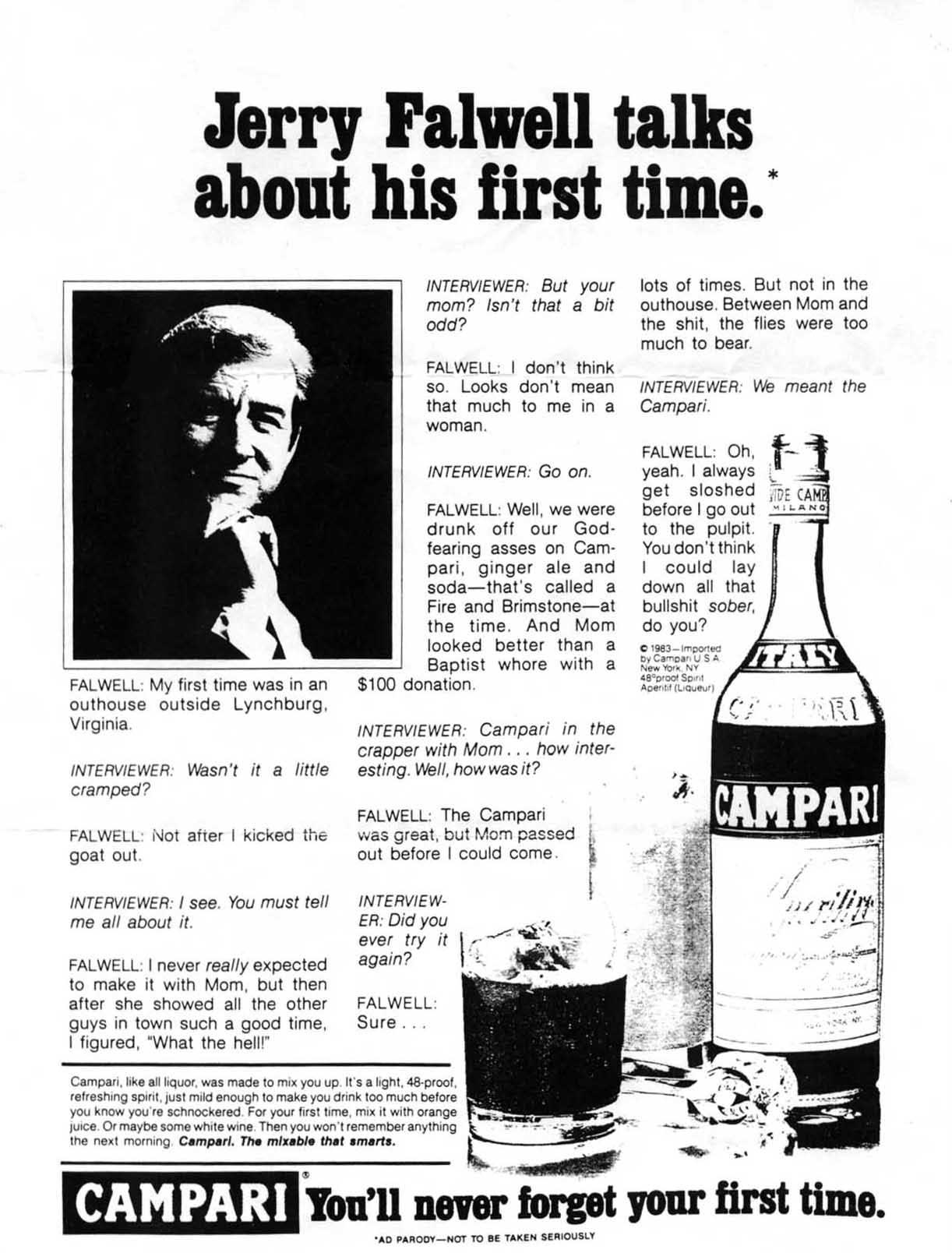
Upon hearing of this furore, the first thing that came to mind was when Jerry Falwell sued Hustler Magazine for 'emotional distress', after a spoof Campari advert implied that he had, well, a not-so-mild case of the Oedipus complex. The US Supreme Court saw sense and ended up throwing out the case.
It all goes to show that the British have satire instead of revolutions - one of the better traditions passed down to us all.
Subscribe to:
Posts (Atom)